A Hymn to British/Saxon/American Nationalism

At the American Society of Church History conference in April, Mary Jane Haemig presented an interesting paper discussing how German-American churches in Minnesota commemorated Reformation Day in 1917. It was the four hundredth anniversary of Martin Luther’s famous posterizing of a church door in Wittenberg–I like to imagine it looked something like this–but the context was challenging given that the United States was currently as at war with Germany. As I mentioned in a previous post, German-Americans were treated poorly during World War 1, enduring both legal sanctions and unofficial harassment. Many native born Americans suspected them of harboring sympathies for the enemy.

This left German-Americans in a bind. They were predominately Lutheran and they wanted to celebrate the man who gave birth to their religious tradition. But Luther, it must be admitted, was quite distinctly German. Celebrating a German national hero could have further alienated already suspicious non-German neighbors. German-Americans tried to diffuse any tension by emphasizing the ways in which Luther contributed to the development of modern democracy and religious freedom. In that same spirit, the Reformation Day celebrations featured many familiar patriotic songs like the National Anthem.

One of the more popular songs sung that day is a bit more obscure unless you happen to be from a Lutheran background. The hymn is based on a poem written in German, “Gott segne Sachsenland” (God save Saxony). The author was Siegfried August Mahlmann, a minor but popular 19th century German poet. Mahlmann set the text to the tune of the British anthem “God Save the King.” After all, why should only the British get to claim that God would “scatter [the King’s] enemies, and make them fall, confound their politics, [and] frustrate their knavish tricks”? God loves Saxons too!

What’s fascinating about the poem is its timing. It was written in 1815 at the tail end of the Napoleonic Wars. Most Americans who are somewhat familiar with the period think of the wars as a clash primarily between Britain and France. It’s easy to forget that almost all of Europe was involved. Saxony had a particularly rough go of it. In 1813 it was the site of French, Russian, and Prussian military campaigns. At the time Saxony, under its ruler Frederick Augustus I, was allied with Napoleon, albeit quite reluctantly having fought against France several years earlier. When Napoleon (and the Saxon Army) were decisively defeated at the Battle of Leipzig that year, Frederick Augustus was taken into captivity by the Prussians, who had designs on Saxon territory. After a year and a half in prison, the Prussians released Frederick and forced him to sign a treaty giving roughly half of Saxony to Prussia. Still, when Frederick returned home, he was hailed as a hero who had saved Saxony from complete destruction.

Mahlmann’s poem was a hymn to Saxon nationalism. He hailed Frederick as the good King and Father who had stood true through storm and night. Mahlmann’s patriotism isn’t surprising given that he himself had spent time in a French prison in 1813. After years caught between the equally rapacious French and Prussians, Saxony had finally seen the dawn of a new era, or so they hoped. The song’s story might have ended there as a minor monument to a forgotten nationalist sentiment (Saxony would be subsumed by the Second German Reich sixty years later). But in 1844 American musician John Sullivan Dwight translated the hymn, removed the Saxony-specific stanzas, and gave the song a second life. Many Lutheran and Episcopalian hymnbooks still include it. Here is Dwight’s version:

God bless our native land!
Firm may she ever stand,
Through storm and night;
When the wild tempests rave,
Ruler of wind and wave,
Do Thou our country save
By Thy great might.

For her our prayers shall rise
To God, above the skies;
On Him we wait;
Thou Who art ever nigh,
Guarding with watchful eye,
To Thee aloud we cry,
God save the State.

God no longer saved the King of Britain or the King of Saxony, but rather the State, a more fitting designee for divine authority in the democratically-minded United States. Thus when German-Americans sang the song with gusto in 1917, they were able to simultaneously declare their loyalty to the American government and assert that they belonged in their new native land.

Let’s recap. A song proclaiming that God had a special relationship to England became an ode to God’s protection of Saxony. Then an American repurposed it as an appeal for God’s preservation of the US federal government. A generation or so later, German-American immigrants sang it to show that they were as loyal to America as any native born citizen. I’m reminded of a J. C. Squire poem:

God heard the embattled nations sing and shout,
“Gott strafe England!” and “God save the King!”
God this, God that, and God the other thing.
“Good God!” said God, “I’ve got my work cut out!”

Meta-Religion

9k=James W. Laine addressed one of last week’s plenary sessions at the American Society of Church History conference. Laine, whose work on the Mughal Empire was provocative enough to get him banned in parts of India, spoke on the concept of “meta-religion,” an idea coined in his latest book.

If I can ludicrously generalize, meta-religion is a totalizing system that accommodates and/or subsumes individual religions, which are tolerated so long as they do not challenge the power of the empire backing the meta-religion. Laine gave the Roman Empire, the Mughal Empire, and the United States as examples, making the point that secularism and civil religion are much-ballyhooed modern variations on a far older concept.

French secularism (laïcité) received honorable mention as an example of how meta-religion remains invisible until a subordinate religious group resists the State. When a group does so, the meta-religion becomes rigid and thus visible, as has been apparent since the passage of restrictions on Islamic practice like the ban on headscarves in primary schools. I wrote down one of Laine’s punchier lines: “As America debated the extent of separation between church and state, France embarked on the even more radical experiment of replacing the Church with the State.”

laicitc3a9

For non-French speakers: “Integriste” is an epithet in France and the cartoon shows how unevenly it’s applied despite the basically identical meaning of the captions.


During the Q&A Laine poked at the audience’s discomfort with conservative challenges to American secularism. Battles over, for example, teaching creationism in public schools are evidences of the rub between an older and a newer American meta-religion. The Protestant consensus of the 19th century is being replaced by a progressive system which is yet equally imbued with faith. After all, Laine noted, the ACLU sides with opponents of creationism in the interests of the separation of church and state. Yet it doesn’t return the favor when a Christian family complains about yoga classes in their public school. When Laine gave that example, the audience chuckled and shifted uncomfortably.

I’d recommend Laine’s book to anybody with an interest in religion and I plan on picking up a copy myself. As an Americanist, I’ll be mentioning it in the same breath as Robert Bellah’s work. As a Christian, it will change how I conceptualize the relationship of the early Church and Rome.

Textbook Wars

Curriculum controversies are a staple of state and local politics. The brouhaha in Kansas is merely the latest in a long line of fights. Creationism is at a constant low grade boil that occasionally overflows the pot. Sex education launched a near revolt in Kanawha County in the early 1970s. Go back still further and you’ll find actual riots over which version of the Bible–the Protestant KJV or the Catholic Douay-Rheims–would be required for use in schools. Since the founding of the first public schools, Americans may have spent more time arguing about textbooks and course content than any other single topic.

Here’s an archival image from a 1970s front in the textbook wars.

School Texts

Image Credit: Harold J. Ockenga Papers, Gordon-Conwell Theological Seminaries Library

You’ve got “Un-Americanism,” the catch-all label for attempts at “debunking” or “falsifying American history.” (Replaced in subsequent decades by the dreaded “revisionist” conspiracy.) It is a letter from the American Association of Christian Schools, so “rebellious spirit” and “disrespect for church, religious, the Bible,” make appearances. It seems that approved textbooks should make America look good, the USSR look bad, encourage respect for authority, and promote middle-class respectability.

Some of the categories are just befuddling. What is a “confusion complex,” are there job postings for “confusion complex” designers, and do they create both commercial and residential complexes? I suspect that my blog, if it had existed at the time, would’ve fallen afoul of at least seven of the eleven offenses. Then again, it’d be rather an honor to be found guilty of “excessive free speech.” Dang it, now I’m a “smart-aleck” and guilty of “vulgarity” to boot.

I will only briefly note that curriculum conflicts are an avoidable problem. The more centralized control of a curriculum is, the more likely a school system is to have a fight over its choice of texts. In Kanawha County, for instance, the state board of education mandated that all local schools include sex ed curricula; a local pastor’s wife ran for the school board and rallied locals in opposition.

Today you see the same pattern with state boards setting curriculum in Texas and Kansas. If each school district was given authority to set its own curricula (and, among other things, test, hire, and fire its own staff), a significant amount of the problem would go away as schools more closely reflected the views of their constituent families.

And let’s be honest with ourselves. Do you really think that forcing a kid to buy a textbook promoting creationism or sex education in a class or two will really make that much of a difference in whether they have a positive life outcome? Oh, if only I’d read a few chapters about evolution, I wouldn’t have become a bank robber! That ascribes far too much deterministic power to formal education, I think.

German-American Lutherans and World War II

During World War I, German-Americans had endured a great deal of suspicion and legal persecution. Some states banned them from instructing their kids in German and/or forced them to attend public rather than their own parochial schools. The pressure very quickly turned petty; German cuisine was renamed such that sauerkraut was renamed “liberty cabbage” and “hot dog” became the new term for frankfurter. A majority of German-American immigrants were Lutheran, but their evangelical identity didn’t do much to protect them from their neighbors.

By World War II, Lutheran denominational leadership had shifted from German-speaking first generation immigrants to a bilingual second generation. As the ties to the old country weakened, Lutherans started embracing American patriotic symbols, flying American flags in their sanctuaries, buying war bonds, and allowing military service and chaplaincy.

Even so, those cultural affinities die slowly and and you might be surprised by what replaces them. In January 1941 a Lutheran pastor in Virginia wrote to a radio station manager. The manager had previously asked the pastor, when speaking on the air, to use “negroes” instead of “darkies” or “colored people.”

One way for German-Americans to fit in was to adopt the dominant racial mores. White supremacy was a way of asserting American identity. Hey, I may be a cabbage-eating Kraut, but at least I’m white! The most extreme expression of this impulse was the German American Bund, the authorized American arm of the Nazi Party. Here’s an infamous picture from a 1939 Bund rally in Madison Square Garden which was attended by 22,000.

Nazi George Washington


I don’t know if the pastor in the letter at hand was a Bund member. In any case, he replied to the manager that he would be more careful in the future and concluded with this line:

Living in a southern, pro-British, Rooseveltian atmosphere in itself makes me rather cautious. Behind all this dirty weather in the world the sun of Grace is still shining!

The pastor was an isolationist opposed to US intervention against Germany in World War II. He likely has in mind the pending Lend Lease Act, passed in March 1941, which would funnel military supplies to the British government on credit (before, the Brits had to pay cash, which they were running out of).

It reads strangely today, doesn’t it? I don’t think that’s just because he’s an isolationist, but because he represents a kind of nationalism which is alien to us. He’s writing in English which makes it likely he’s at least a second generation German-American. Yet his affinity for Germany (and antipathy for Britain) is affecting his views of US policy. He then cloaks that nationalism in religious language. The threat of American intervention is “dirty weather” covering up the “sun of Grace,” implying that God is on the German-American isolationist side.

I think moments like these are instructive for us today. I do not doubt that for this Lutheran pastor his hybridized national identity felt as natural as breathing. This should provoke us to reflect on how our own national and racial identities sub-consciously shape our attitudes, politics, and loyalties.

Communists, They Are Everywhere, But Sunday School Will Save Us!

I was reviewing my archival research and came across this cover from Teach (“The Sunday School Idea Magazine”).

Sunday School Communism

The rhetorical question is more than a bit silly. But J. Edgar Hoover took a break from illegally wiretapping civil rights groups to contribute an article. Hoover served up his usual strong dose of civil religion; Christianity had value because it inspired “moral idealism” in America’s youth, protecting the US against Red subversion.

What’s interesting to me about documents like this is that they show the extent to which anti-Communist rhetoric pervaded the post-World War Two cultural and political consensus. Democrats and Republicans competed to see who could be most vociferous in their condemnations of Communism. Everywhere you looked you’d see anti-Communist material, from refrigerator advertisements to graphic novels. It was so pervasive that it became kind of meaningless, just a part of the rhetorical background. (Albeit a “meaninglessness” that could bite. Just ask anybody blacklisted at the time.)

I’m not sure there’s a perfect corollary today. Maybe think of it as the mid-twentieth century version of contemporary consumer environmentalism. You’d be hard pressed to find a major American corporation today that doesn’t give at least lip service to conservation. A few years ago, Poland Spring announced thinner plastic bottles to save the earth. The bank I used to work at changed it’s slogan to “Go Green!” and instituted a cap on our monthly printing. Even oil companies pay for lavish pro-environment ad campaigns. It’s generally just posturing. They dress up moves to help the bottom line as altruism.

The major difference between then and now is that while environmental conservation has reached peak cultural consensus, it hasn’t created the kind of political consensus that backed anti-Communism during the Second Red Square. We don’t have a House Un-Environmental Activities Committee subpoenaing testimony from polluters. Oh, wait. Still, the point stands, I think.

The FCC’s New “Just and Reasonable” Standard Could Be Anything But

2000px-FCC_New_Logo.svgOn March 12 the FCC issued its 400 page ruling on net neutrality. Vox’s Timothy Lee has an excellent overview of the ruling that I’d recommend reading before you continue with my post.

I have already expressed my concerns about the relationship between net neutrality and rent seeking behavior, so I won’t rehash them now. What alarms me about the new rules is a step the FCC took that went beyond net neutrality proper. The Commission annexed for itself the general power to determine whether broadband providers’ conduct is “just and reasonable.” Even companies complying with net neutrality rules could still be investigated for violating this new standard. It works via a system of public complaints. If you (or, more likely, a major internet content provider) believe your broadband provider is being unjust or unreasonable, you can complain to the FCC. It will then consider violations of the “just and reasonable” standard on a case-by-case basis. In fact, the FCC has given no actual definition of what constitutes “just and reasonable” conduct. The Commission will make it up as it goes.

This piques my interest because I’ve spent the past few years studying the damage wrought by an equally vague FCC rule regarding radio broadcasting. In the Radio Act of 1927, which established the Federal Radio Commission, the agency was charged with assigning and renewing radio station licenses so long as they used their licenses to serve the “public interest, convenience, or necessity.” This brief, vague line opened the door to years of lawsuits and some incredible abuses of government power for partisan political purpose.

Part of the problem with the standard was that it did not define the public interest, convenience, or necessity. In the 1940s, progressives argued that commercials were not in the public interest and the FCC moved to limit the amount of airtime that stations could devote to selling King Biscuit Flour and other sponsored products. The industry rallied in opposition to the proposed rules which were promptly dropped by the FCC. In the 1950s some on the commission worried that there were too many violent Westerns being broadcast–think about the children!–and they wanted stations to air more public service time covering the news and editorializing on “controversial issues of public importance.” In 1959 these principles were codified by the FCC as the Fairness Doctrine.

The FCC had set itself up as the arbiter of the “public interest.” Opponents of the proposal argued that people could just vote with their dial in a democracy of the airwaves, but the advocates believed that the public had a bad habit of voting for things (Westerns, boo!) that were not actually in their own interest. Instead, a non-elected board of lawyers, few with communications experience, would decide what the public truly needed. I don’t have time to go into the particulars of the Fairness Doctrine here–that’s what my dissertation is for–but it did not take long for the new rules to be abused for partisan purpose.

With the advent of mass television the networks had left the expansion of radio in the hands of financially-struggling, independent stations.They were willing to take programming from whoever could pay and conservative broadcasters like Carl McIntire, Billy James Hargis, and Clarence Manion could pay in cash. By the early 1960s about a dozen conservative broadcasters aired on a hundred stations or more nation-wide. But unlike the networks, which could hire lawyers and former FCC commissioners by the bushel, these small stations were vulnerable. When the FCC wanted to make an example out of a station, better to go with a rinky-dink operation. Henry Geller, a former FCC counsel, once described the FCC’s informal “three outhouse” rule of thumb. If a station had more than three outhouses, it was approaching a size that made it dangerous for the FCC to mess with.

Right-wing broadcasting graduated from minor irritant to major political nuisance by the early 1960s. In particular, conservative opposition to the Nuclear Test Ban Treaty undermined the Kennedy Administration’s policy program and hurt the President’s reelection prospects for 1964. So in the fall of 1963 the Administration pushed the Internal Revenue Service to audit all the major conservative programs in hopes of scaring off their donors. Furthermore, President Kennedy encouraged the newly appointed Chairman of the FCC to keep the airwaves “fair” by more tightly enforcing the Fairness Doctrine. Fairness, like beauty, is in the eye of the beholder, which in this instance was the Kennedy Administration, the Democratic National Committee, the United Auto Workers, and the National Council of Churches. (Again, more details in the dissertation.)

Here’s where the vagueness of the Fairness Doctrine rules came into play. Stations were told to editorialize on current events, like the Nuclear Test Ban Treaty, but also to give both sides a fair hearing. If they aired an attack on the Test Ban Treaty, they were obligated to air a response from supporters of the Treaty. Ostensibly the rule applied to all sides and would ensure that both liberals and conservatives got to moot their opinions. The intended goal was a government-guaranteed marketplace of ideas on the airwaves.

Yet in practice the Fairness Doctrine was exclusively targeted at conservative broadcasters. Liberal interest groups–abetted by the DNC and the Administration–would lodge a complaint with the FCC whenever a station aired a conservative program attacking a liberal group or policy. The FCC would notify these stations of the complaints and mention that they would be taken into account at the station’s next license renewal hearing. Alternatively, the stations could agree to air response programs from these liberal interest groups. But here’s the kicker…they had to do so without charging for airtime. For example, when conservative program Life Line (funded by a Texas oil millionaire) paid radio stations to air an episode criticizing the Nuclear Test Ban Treaty, the pro-treaty Citizens Committee for a Nuclear Test Ban wrote to the station demanding free response time. The FCC backed the request–resulting in the “Cullman Doctrine”–and many stations complied. This made airing conservative programs a financial liability and all but the most ideologically-motivated station owners began dropping Right-wing programming in droves. By 1968 most conservative programs aired on a quarter or a third of the total number of stations as they had in 1963.

We know about this partisan use of the FCC in the mid-1960s because a number of the major players began to regret their actions post-Watergate. They had used the FCC to bully stations into airing less anti-Administration programming, but it didn’t take more than a few years of Nixon to realize how stifling that could be once the shoe was on the other foot. They leaked information and documents to a former CBS news executive named Fred Friendly who wrote a book on the topic. One chapter of my dissertation expands on Friendly’s story using documents from labor archives, the DNC, and the JFK Presidential Library.

Let me end by listing some of the unintended consequences of the vague “public interest, convenience, or necessity” standard of the Radio Act of 1927 and its regulatory descendant the Fairness Doctrine:

1) Major companies were generally protected from any adverse consequences because of their deep pockets.
2) The burden of compliance fell disproportionately on new, struggling independent stations.
3) The rules were hijacked to serve partisan, political ends.
4) Stations dropped voices from the political periphery.

Of course, the FCC’s “just and reasonable” standard isn’t identical to the “public interest, convenience, or necessity” standard that gave rise to the Fairness Doctrine. Still, the Commission’s poor track record in enforcing this old vague standard should give us pause about a new vague standard. If the past history of the FCC is any guide, future Commissions will interpret the “just and reasonable” standard in ways that benefit the loudest, best-connected, and most well-financed lobbying groups. Regulatory capture is the bane of administrative law and the vaguer the rules, the more opportunity there is for incumbents to shape those rules in ways that benefit established interests.

J. Roswell Flower Visits Bob Jones College

J. Roswell FlowerIn June 1946 J. Roswell Flower visited Bob Jones College in Cleveland, Tennessee to receive an honorary doctorate from the institution. A year later, Bob Jones College would become Bob Jones University and move its campus to Greenville, South Carolina.

Flower was an influential voice within pentecostalism. He was one of the youngest representatives present at the formation of the Assemblies of God in Hot Springs, Arkansas in 1914. He served in a variety of executive posts within the nascent denomination and played a vital role in its “evangelicalization.” During his career, the Assemblies moved away from its historic support for pacifism, softened its stance on speaking in tongues as a necessary sign of salvation, and engaged more broadly with other evangelical denominations. Indeed, the Assemblies of God was the largest denomination to join the National Association of Evangelicals in the 1940s and it saved the organization from financial collapse multiple times. Flower brought pentecostalism into the evangelical mainstream.

The choice of Flower is interesting because Bob Jones University eventually withdrew from broader evangelicalism and also became increasingly critical of pentecostalism. Take, for example, the position advocated in a 1989 book published by BJU’s press, Pentecostalism: Purity or Peril? (Hint: These kinds of books always put the correct answer second.)

But that future would’ve been unimaginable to students at Bob Jones College in the 1940s. Bob Jones Sr. was a founding member of the National Association of Evangelicals. He was even then embroiled in a competition for students with the archly-fundamentalist Wheaton College. When Wheaton President J. Oliver Buswell attacked Bob Jones College for putting on “worldly” operas and Shakespearean plays, Bob Jones Sr. responded with a ringing call for Christian liberty of conscience. A betting man would have put his money on Bob Jones College as the future flagship institution for this new form of evangelicalism. And he would’ve lost every penny.

Flower’s visit to Bob Jones College is a reminder of how fluid the state of evangelicalism was in the 1940s. The labels and lines that are familiar to contemporary evangelicals and fundamentalists would not harden for at least another decade.

In our quarterly letter dated March 1 we stated that prejudice against the Assemblies of God is melting perceptibly. It is possible to mingle with others without compromise and to gain respect for our Christian testimony. Recently, the writer had the opportunity to prove this statement. He was given the privilege of visiting Bob Jones College at Cleveland, Tenn. during its Commencement exercises. Both Bob Jones Sr. and Bob Jones Jr. were most cordial and friendly….

Bob Jones was reminded that a short time ago he had spoken in one of the Assemblies of God in Seattle, Wash…. He said that when the time came for prayer, an intelligent, cultured woman began to pray in an unknown tongue. When she had finished, a man, well dressed, intelligent, said, “I will interpret,” and immediately began to pray in English. Bob Jones said, “I have been in this way for a long time and you can’t fool me. That was of God and I knew it.” He went on to say that we may not fully understand this speaking in tongues, but when the Spirit of God moves he could recognize it….

Incidentally, about seven or eight students came to us to inform us they were Assemblies of God members. Two of them graduated with honor. I was called upon to speak in the Sunday morning Chapel service. I did not discern a particle of prejudice at any time, and the announcement was made publicly of my position in the Assemblies of God. Since my return home, I have contacted other young men and women who plan to attend Bob Jones College. I believe, from my own experience there, no attempt will be made to break down their Pentecostal testimony.

In fact, Brother J.L. Slay, a former C.B.I. student and now pastor of the Church of God in Cleveland [a Pentecostal church], told me that more students attend his church than any other church in town, and the college does not oppose them. We learned also that the Church of God Publishing House does practically all the printing for the college.

Thank you to the aptly-named Flower Pentecostal Heritage Center for the document these quotes are from. During my visit to Springfield, director Darrin Rodgers was a gracious host who even took the time to give me a tour of the facilities and showed me around town.

Christian Nationalism in Surprising Places


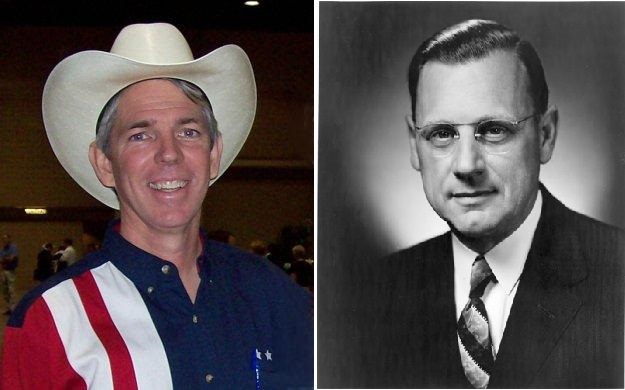
David Barton, Harold Ockenga

Photo Rights, David Barton: cwmemory.com Photo Rights, Harold Ockenga: Fuller Seminary David Allan Hubbard Library

American Christian nationalists believe that God anointed the United States of America as a spiritual successor to the Old Testament nation of Israel. America was chosen, so the story goes, because of the faith of the colonial settlers. The Puritans founded an American “city on a hill” that was tasked with an exceptional mission to shine the gospel light on the rest of the world. Then the Founding Fathers, most of whom were evangelical believers, enshrined Christian values in the Constitution. Unfortunately, later generations of Americans have fallen away from that state of grace. But should Americans repent and turn from their secular humanist ways, America might once again find itself the recipient of God’s blessing.

Christian nationalism is both theologically and historically hogwash, but it’s not my purpose in this post to specify why; better historians than I have already given it their best shots. What I do want to point out is that Christian nationalist thinking has been much more mainstream among evangelicals than is commonly portrayed in contemporary discussions about New Christian Right activists.

Take the example of Harold J. Ockenga, who is known for his role in the creation of a “new evangelicalism” during the 1940s and 1950s. Theoretically he represents a milder, less militant form of fundamentalism. Yet here is a 1943 address he gave at the founding convention of the moderate National Association of Evangelicals under the heading, “America Will Determine World Destiny” [emphases my own]:

I believe that the United States of America has been assigned a destiny comparable to that of ancient Israel which was favored, preserved, endowed, guided and used of God. Historically, God has prepared this nation with a vast and united country, with a population drawn from innumerable blood streams, with a wealth which is unequaled, with an ideological strength drawn from the traditions of classical and radical philosophy, with a government held accountable to law, as no other government except Israel has ever been, and with an enlightenment in the minds of the average citizen which is the climax of social development.

He continued later,

Apparently the last great privilege of ministering to mankind was committed to this particular nation. That is a tremendous responsibility for which we are answerable. We have the enlightenment. We have the historical tradition. We have the material means. We have the leadership. We have everything which is necessary in order to evangelize the world. Now we have entered into our maturity, and we are facing an accounting for that destiny. If America fails to discharge its responsibility darkness must ensue.

Ockenga was appealing for the creation of a united evangelical front in America. As I argue in my dissertation, this was the moment when “evangelicalism” transformed from a mere description of theology into a term of identity. Ockenga harnessed this Christian nationalist rhetoric because he believed it would unite disparate Protestant groups–including Pentecostals, Baptists, Presbyterians, and Methodists among many other groups–against their common enemies (modernists, Catholics, etc). Christian nationalism has been at the heart of American evangelical identity for much longer than you may have thought.

Ockenga’s speech was transcribed in the Pentecostal Holiness Advocate, vol 27, no 3 (20 May 1943).

The Parable of the Unforgiving Prosecutor

Hear ye the word of Ben Mathis-Lilley, chapter 18, verses 23-35:

Therefore are the United States likened unto a certain attorney general, which would take account of his civil servants. And when he had begun to reckon, a St. Louis county prosecutor was brought unto him, which owed him $170,000. But forasmuch as he had not to pay, the attorney general commanded him to be fired, and his assistant prosecutors, and all that he had, and payment to be made.

The county prosecutor therefore fell down, and worshipped him, saying, “Attorney general have patience with me, and I will pay thee all.” Then the attorney general was moved with compassion, released him from jail, and forgave him the back taxes.

But the same prosecutor went out, and found a disabled military veteran, which owed him a $100 payment on his traffic fines; and the prosecutor had the police lay hands on him, and put him in handcuffs, saying, “Pay me that thou owest!”

And the disabled veteran fell down at his feet, and besought him, saying, “Have patience with me, and I will pay thee all of the fines.” And the prosecutor would not listen, but went and cast the disabled veteran into prison, till he should pay the debt.

So when the disabled veteran’s friends saw what was done, they were very sorry, and came and told unto the attorney general all that was done. Then the attorney general, after that he had called the prosecutor, said unto him, “O thou wicked civil servant, I forgave thee all those back taxes, because thou desiredst me: shouldest not thou also have had compassion on this disabled veteran, even as I had pity on thee?”

And the attorney general was wroth, and delivered him to the tormentors at the Internal Revenue Service, till he should pay all that was due unto him. 

And the attorney general was wroth, and wrote a sternly worded report outlining the prosecutor’s sins and those of his fellow civil servants in St. Louis county. Little else happened, for great is the indifference of the United States.

Rent Seeking and the New Net Neutrality Rules

Net Neutrality
Yesterday the Federal Communications Commission voted to implement net neutrality rules banning internet service providers (ISPs) from privileging content from any one source over another. The worry was that ISPs would create “fast” and “slow” internet lanes based on payments from content creators. A company like Netflix might pay Comcast for priority on its broadband network, relegating competing companies to slower, stuttering service. Allowing that to happen, net neutrality advocates say, would result in a two tier access to the internet that will hurt poorer Americans, discourage internet startups, and line the pockets of already wealthy ISPs. Given how widely hated ISPs are–11 of the 15 least popular companies in America are cable or broadband providers like Comcast, Time Warner, and Charter Communications–it’s not surprising that a record 3.7 million pro-net neutrality comments were registered with the FCC in 2014.

ISPs and others opposed to net neutrality have argued that the rules will slow the expansion of faster broadband. Making broadband less profitable, the argument goes, will give companies less incentive to invest in new lines. Furthermore, opponents note that future internet innovation could very well depend on paid prioritization. For example, as telemedicine applications boom, wouldn’t you want your connection to your doctor across the country to be prioritized over someone playing Call of Duty? Lag when you’re shooting fake terrorists is less dangerous than if a doctor is controlling a distant surgical robot in a real isolated military outpost.

One of the odd aspects of the debate is how theoretical it is. The internet is one of the great technological innovation success stories of the past two decades and it became so with very little government regulation. Why, suddenly, are new rules needed now? After all, there is only a single concrete violation of net neutrality principles in recent years. In 2007 the FCC slapped Comcast’s wrist for “bandwidth throttling” when it discriminated against peer-to-peer traffic (P2P) . At the time ISPs had found that a massive proportion of bandwidth was consumed by P2P activity, between 49 and 95% depending on time of day, with most of that traffic coming from less than 1% of internet users. Heavy P2P downloaders of (mostly) illegal music, movies, porn, and games were clogging up the internet for everyone else. Comcast started throttling speed for those uber-users in order to speed up other customers who paid just as much for access. Yet net neutrality advocates worried that the action set a bad precedent. Comcast backed off under FCC pressure.

It’s a debatable issue, but what concerns me, as well as the generally pro-net neutrality Electronic Freedom Foundation, is how vague some of the new rules appear to be (the text of the new rules won’t be released for several more weeks). As the EFF put it in a letter to the FCC:

A “general conduct rule,” applied on a case-by-case basis with the only touchstone being whether a given practice “harms” consumers or edge providers, may lead to years of expensive litigation to determine the meaning of “harm” (for those who can afford to engage in it). What is worse, it could be abused by a future Commission to target legitimate practices that offer significant benefits to the public.

When the EFF refers to “those who can afford to engage in it,” its has in mind very profitable ISPs like Comcast, which had a cool $2.59 billion in income in its last reported quarter. Well-heeled companies are better able to afford to fight the rules in court as well as to cover the cost of compliance should they lose. ISPs should come through the new rules, whatever they end up being, relatively unscathed; they might not like them, but they’ll find a way to turn them to their own benefit. Regulation that preserves the status quo tends to favor incumbents and the new rules–which don’t appear to include an unbundling provision–may make it harder for new entrants to compete in the marketplace. Product differentiation, a key way for new companies to compete with incumbents, is now banned although they’ll still be able to compete on price.

Might this hurt new internet content creators as well? Imagine you’re a challenger to Netflix trying to break into the world of online video streaming. They are the 600 pound gorilla. So you make a deal with Google Fiber to allow their base level users–who pay nothing for 5 mbps download speeds–to also receive the 15 mbps speed necessary for HD streaming for no charge but only for your service. It’s a loss leader but it’s a way of trying to challenge the dominant market leader. Google wins–getting bucks from the upstart. The upstart wins–gets a shot at increasing market share. The public wins–get more free access to content. Only one person loses–Netflix.

Less you think this stranger than fiction, note that there are some past examples of cell providers trying to gain an edge over their competitors by not charging subscribers for data when they access certain websites or music services. There’s a precedent for this.

In that light, it’s no wonder that current internet companies tend to favor net neutrality. It protects them from future competitors. In other words, net neutrality isn’t just a story about little content creator Davids facing off against big ISP Goliaths. It’s also an attempt by incumbent internet content providers to protect against upstarts. Rent-seeking in all things, apparently.

Stay tuned later this week for some thoughts on how the FCC’s missteps with the Fairness Doctrine in the 1960s should give us pause over implementing net neutrality.